How to Earn Enterprise Trust in AI: A 4-Phase Framework
Nearly 9 in 10 enterprise AI pilots never reach production. The gap is trust, not model capability. The 4-phase framework and architecture to earn it.
Enterprise AI doesn't have a capability problem. It has a trust problem.
The models have been good enough for a while. The projects just stall before production. Gartner expects at least 30% of generative-AI projects to be abandoned after proof of concept by the end of 2025, and more than 40% of agentic-AI projects to be canceled by 2027 — blaming poor data quality, weak risk controls, runaway cost, and unclear value. Notice what's not on that list: model quality. The technology works. Most organizations just never get to use it.
And it's the trust side falling behind, not the tech side: three out of four organizations admit their governance hasn't kept pace with AI adoption.
The delta between what AI can do and what organizations let it do is the trust deficit. Close that, and the ROI is already waiting on the other side.
What enterprises are actually afraid of
When I talk to CTOs in regulated industries, the hesitation is never "the model isn't smart enough." It's seven concrete fears — data security, access control, auditability, reliability, explainability, ROI, and change resistance — and each is a question a board or a regulator will ask:
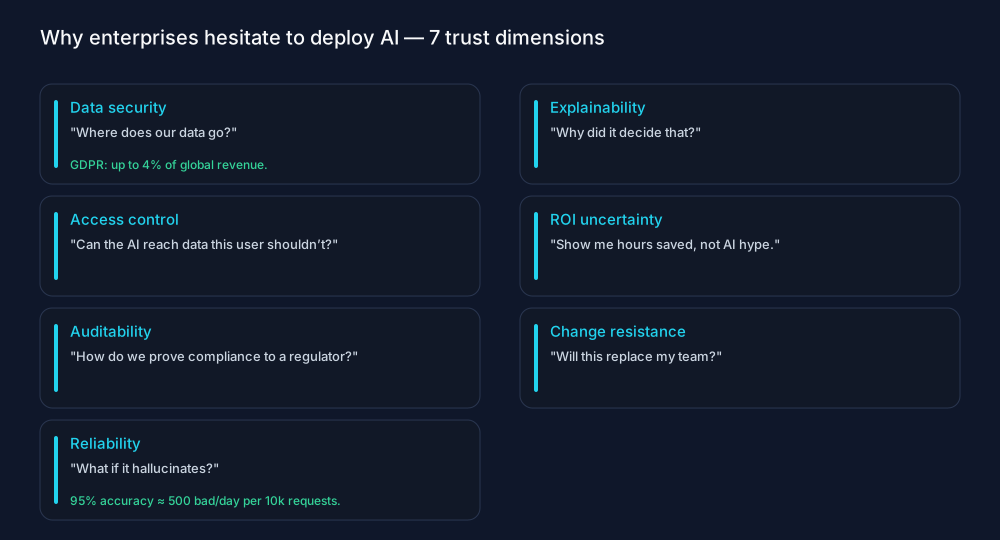
Notice how few of these are model-quality questions. They're trust questions. And you don't answer a trust question with a better benchmark — you answer it with architecture and a deployment process that earns confidence incrementally.
Earn trust in four phases, not one launch
The mistake is treating production as a single leap of faith. Replace the leap with a staircase. Here's the journey we run.
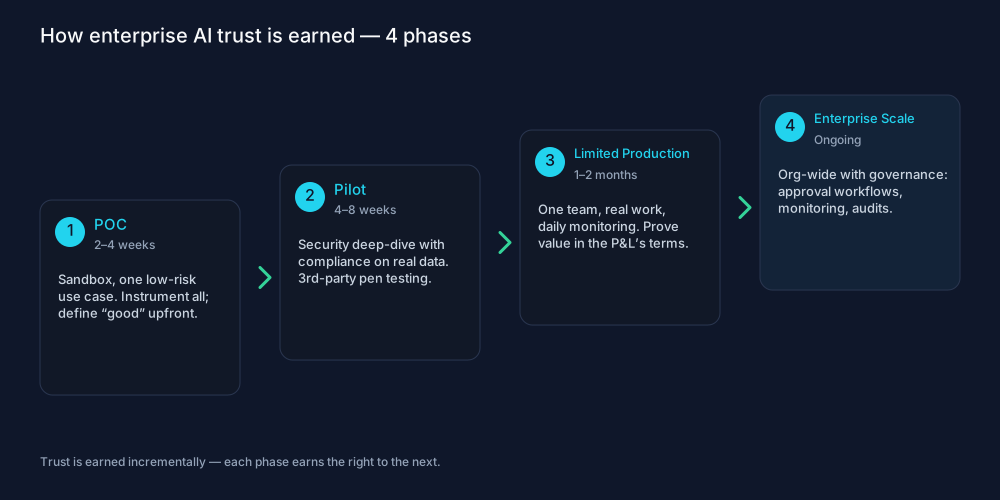
Phase 1 — POC (2–4 weeks). Pick one low-risk, high-value use case and run it in a sandbox. The goal isn't a highlight reel; it's to prove the workflow survives real inputs and to build internal champions. Instrument everything from day one and define "good" upfront — in the production AI systems we've built for regulated clients, that meant targets like >85% request completion and <2s p95 latency locked in as non-negotiables, not aspirations.
Phase 2 — Pilot (4–8 weeks). This is where most pilots die, and it's avoidable. Do the security deep-dive with compliance in the room, on real data in an isolated environment, and bring in third-party penetration testing. Compliance is a design input, not a review gate. Concretely, that's the architecture that answers the seven fears:
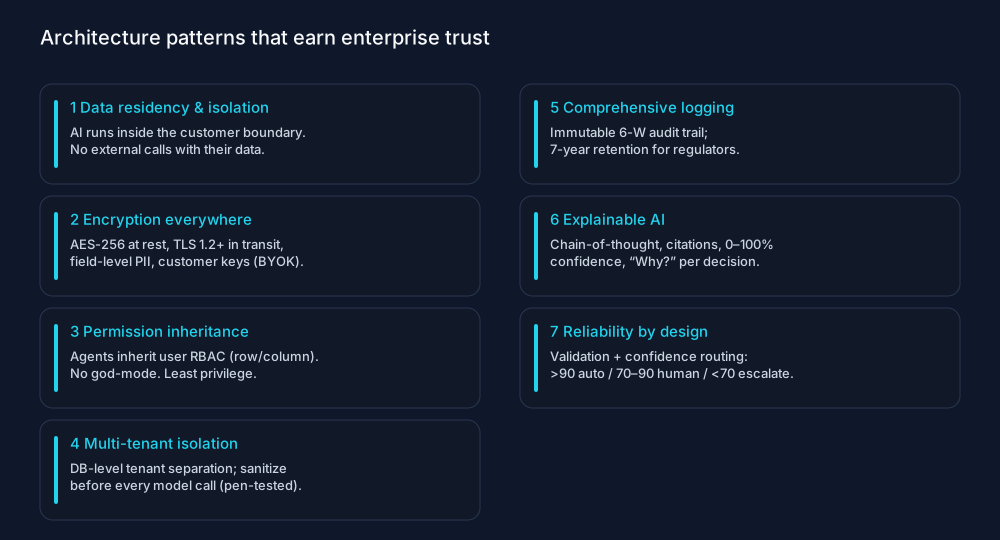
Taking each in turn:
Data residency & isolation — the AI runs inside the customer's own environment. Their data never leaves it and never goes to an outside service — and the logs prove it.
Encryption everywhere — data is protected wherever it sits and wherever it moves, with the most sensitive fields locked down individually. Customers can even hold their own keys.
Permission inheritance — the AI only sees what the person using it is already allowed to see. No all-access "god-mode" agent.
Multi-tenant isolation — every customer's data is walled off from every other's, and sensitive data is stripped before it ever reaches the model. We test that wall by trying to break it.
Comprehensive logging — every action is recorded — who asked, what it saw, what it decided — in a log that can't be edited and is kept for regulators.
Explainable AI — for every decision, the AI shows its reasoning, its sources, and how sure it is. "Trust but verify" only works if you build the verify part.
Reliability by design — every answer is checked first. Confident ones go through automatically, borderline ones go to a human, and if the model fails the system falls back to fixed rules.
Across the enterprise teams I've taken through SOC 2 Type II and ISO 27001 certification in regulated FinTech, the systems that sailed through were the ones where this was architected in. The ones retrofitted for audit cost weeks. Regulators in 2026 — the EU AI Act, GDPR — are only raising this bar.
Phase 3 — Limited Production (1–2 months). Go live, but narrow: a single team, real work, daily monitoring at first, and a tight feedback loop. This is where logged behavior becomes lived trust — and where you make the value undeniable in the business's own language: developer-hours saved, tickets deflected, error rates down, deploy speed up — measured against the Phase-1 baseline, not a slide about "AI transformation."
Phase 4 — Enterprise Scale (ongoing). Only now do you scale org-wide — and scale means governance, not just more seats: a governance framework, approval workflows, continuous monitoring, and regular compliance audits. Governance isn't the tax you pay for scale; it's what makes "yes" a safe answer.
The pattern underneath all four phases
Successful enterprise AI needs alignment across three dimensions — technology, process, and people — and technology is only one of them:
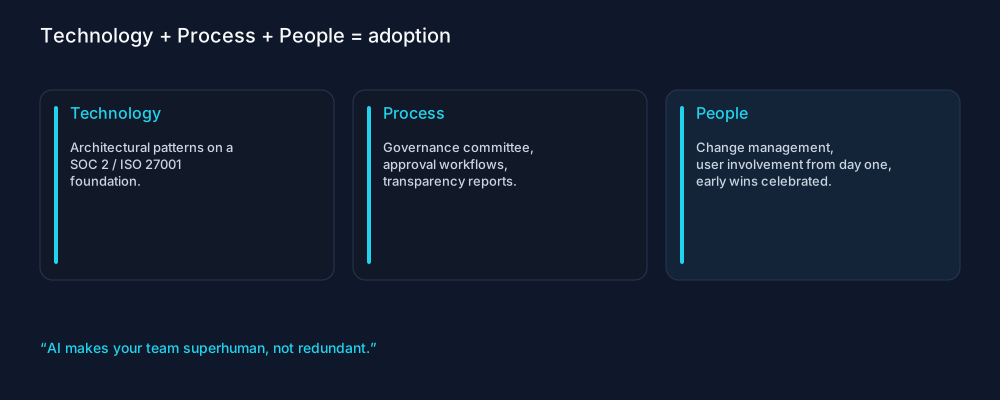
The people dimension is the one engineers most often skip and most often lose on. Frame adoption as empowerment: AI makes your team superhuman, not redundant. When developers see AI generating code and hear "automation," you've already lost the room.
And the discipline that ties it together: under-promise, over-deliver, and show value before asking for more scope. Share what works and what doesn't. Co-create with users. Measure everything. Each phase validates the patterns and earns the right to the next.
The organizations that stall aren't short on models. They're short on a way to move from "impressive" to "trusted" without a leap nobody will take. The framework is how you replace the leap with a staircase.
Trust doesn't arrive. It compounds. And in enterprise AI, it's the only thing that turns a pilot into production.